
The British colonial settlement of New South Wales (NSW) began in 1788 with the arrival of the First Fleet – approximately 1500 convicts, soldiers, officials, and their families. With only about 200 women on board, the demographic pattern was set for the next 60 years with a small female population outnumbered by men. Over time, this gender imbalance came to be understood as a problem for two reasons: first, colonial society was clamoring for female domestic servants and second, because the settlement desired a supply of white women to reproduce the racial logics of settler colonialism as wives and mothers. To solve this problem, first the British government and later the NSW government designed a series of assisted immigration schemes to subsidize and encourage immigration by single (unmarried), working-class women.
The number of immigrants, especially female immigrants, arriving in Australia under different schemes, their origins, characteristics, and outcomes, have been popular topics for historians including the pioneering work of Robin Haines, Eric Richards, Robert Schulz, Jan Gothard, and Trevor McClaughlin.1 Much of this scholarship relied on statistical summaries in annual immigration reports which provided a robust picture of the over-arching demographic trends. The digitization of the original shipping records, the expanded power of personal computing, and the development of digital humanities techniques mean that it is now possible to take a closer look at the outliers, identifying specific populations and individual stories within the larger cohort.
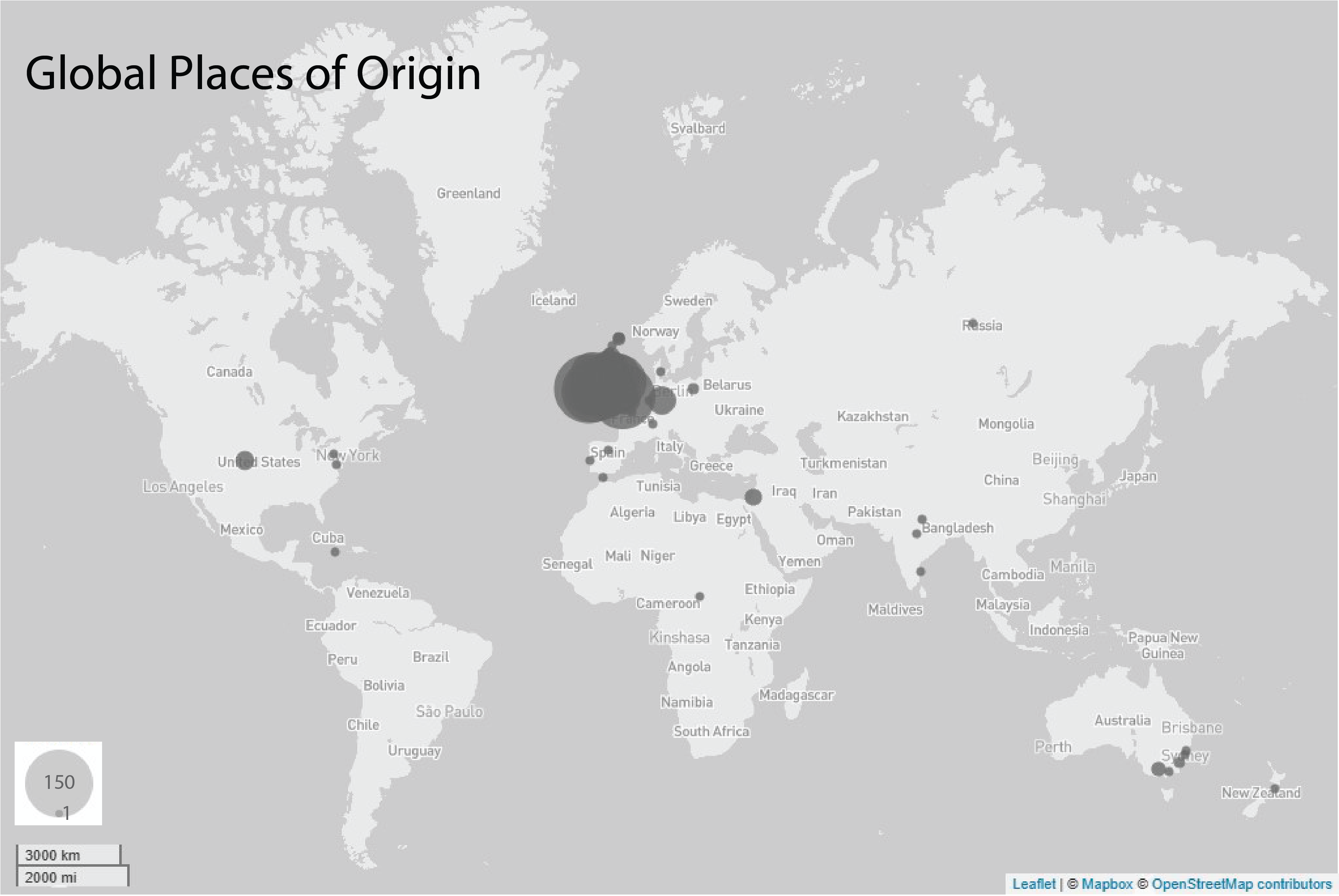
While immigrants from England, Ireland, and Scotland make up 96 percent of the immigrants in this sample, zooming out to the rest of the world reveals the unexpected variety of places that female immigrants came from. Tracing the stories of these women reveals circuitous histories of inter- and intra-imperial migration, of return migration, and of global connections which belie dominant historical narratives of women’s movements in the nineteenth century.
Single Female Assisted Immigration to NSW
By the 1840s the British colony of NSW was in a period of transition. Convict transportation ended in 1840 while free emigration, which had been slow because of the cost and length of the passage to Australia, was growing rapidly after the introduction of assisted immigration in 1831. Under this policy, the British government subsidized the cost of immigration for workers in particular categories, while those already in the colonies could sponsor tickets for family and friends.
One particularly desirable category for the colonial government was single women who would work in domestic service or on farms. The legacy of convict transportation, and the systems which supported it, meant that in 1833 there were 3.5 men to every woman in NSW.2 This was a topic of much concern discussed regularly in colonial newspapers and in government documents with the importation of women explicitly linked with the expansion of colonial territory and the moral foundation of the colony. 3 Colonists saw the gender imbalance as a problem both because the racial logic of settler colonialism required white women to give birth to a self-sustaining population and because the Victorian-era gendered division of labor saw unmarried women as the only appropriate workers in domestic service. As a result, there was significant pressure for first the British government and later the colonial government to encourage immigration by single women. However, early schemes faced widespread public criticism and resulted in relatively small numbers of women arriving.4
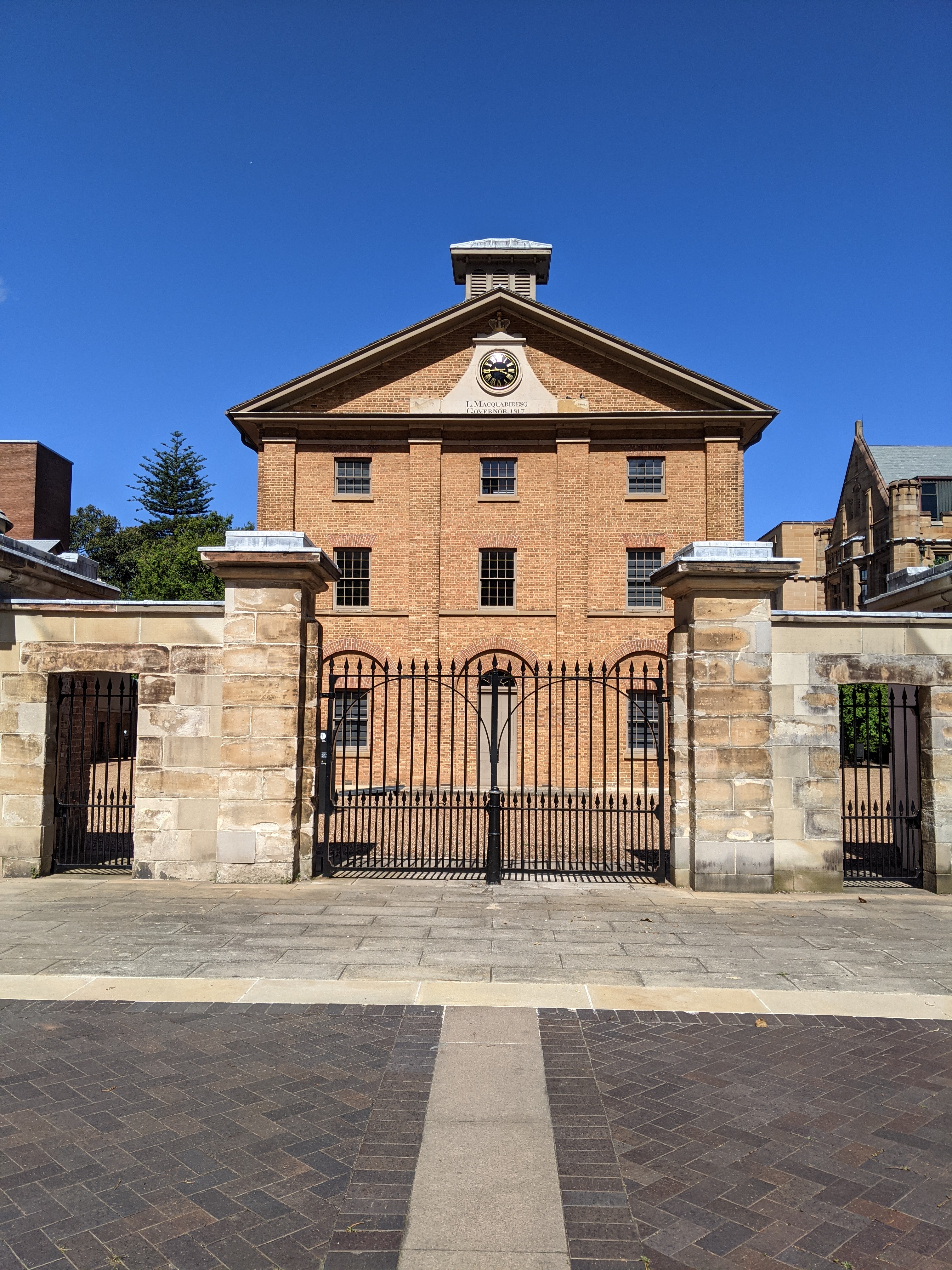
Assisted female immigration to NSW began again in earnest in 1848 with the Colonial Land and Emigration Commissioners (CLEC) taking a more direct role in managing female assisted immigration. They used matrons on board the ships to supervise single female immigrants, segregated them from other passengers on board, and introduced a system of immigration depots to house female immigrants on arrival and assist them in finding employment. The Female Immigration Depot (Figure 1) in Sydney opened in Hyde Park Barracks in 1848 for the reception of 183 Irish Orphan Girls on board the Earl Grey as part of Earl Grey’s Famine Orphan Scheme.5 Over the next four decades, ending with the arrival of the S.S. Abyssinia in 1887, at least 34,330 women and children stayed at the Barracks.
Mapping the Origins of the Female Immigrants
As part of a larger project on the history of the Female Immigration Depot in Sydney, I used information from the Assisted Immigrants Digitised Shipping Lists (1828-1896) held in the State Archives Collection to understand the demographics of the single female assisted immigrants.6 I first cross-referenced the arrival of ships between 1848 and 1887 with digitised newspaper records on the National Library of Australia’s research portal Trove, then selected one ship from each year at random. Since ships were often filled under a particular scheme, typically with immigrants drawn largely from one region, this method means that the dataset is not truly representative but reflects the limitations of time and resources available for the project. This method was designed to focus on change over time, revealing the effects of changing legislation and technology on the flow of single female immigrants. This choice also means that the dataset, which is openly available through the Stanford Digital Repository, can be easily expanded upon by myself or other researchers in the future.
My research assistant, Bonnie Montgomery, helped me to transcribe information from the shipping records into a spreadsheet. In total, we transcribed the details for 3,768 women and children who arrived in Sydney between 1848 and 1887. One of the key pieces of data we collected came from a column labelled ‘Native Place and Country’. Exactly what is being captured under this heading is not always clear; in some cases, it may be referring to birthplace and in other cases it may refer to place of residence prior to immigration.7 This category also presents other challenges because the locations were recorded with different levels of specificity, and because many Irish names were recorded phonetically by English-speaking recorders. I used Recogito, Google Maps and townlands.ie (a crowd-sourced mapping project that was part of OpenStreetMap Ireland) to identify the standardized names and locations of these entities. Where the town name could not be identified, a higher level (region or country) was used. After this process, only 23 of the women and children did not have co-ordinates assigned to them because no location was given in the original record (generally either because the individual was born or died on the ship), or because the original location was too ambiguous (e.g. Mary Anne Galway on the Earl Grey in 1848 gave her native place as being born on a ship travelling to the East Indies). These 23 individuals are not shown in the following maps produced with Palladio.
Expected Origins
Visualizing the origins of female immigrants to NSW hammers home the fact that the overwhelming majority of nineteenth-century immigrants to Australia were from the United Kingdom of Great Britain and Ireland. Given that NSW was a British colony, this is hardly surprising, but seeing this pattern on a map adds weight to the sheer numbers in question. The ideal proportion of immigrants coming from different parts of the United Kingdom was hotly debated in the Australian press. Anti-Irish and anti-Catholic sentiment was rife, and newspapers openly called opined that “Our money ought to be expended upon the rosy-cheeked girls of England, who are pining away without profitable employment…”.8 However, it was generally easier to find willing emigrants in post-famine Ireland. In 1856 the CLEC reported that “… finding ourselves totally unable to obtain trained domestic servants, or, indeed, any adequate number of English single women, we have unhesitatingly had recourse to Ireland, where large numbers of women are anxious to emigrate…”9
While the official policy was to provide subsidized passages to female immigrants in proportion to the population of England, Scotland, and Ireland, the immigration records show that this was not achieved in practice. Irish immigrants made up a total of 39% of arrivals in NSW between 1848 and 1860, although Ireland was only 24% of the population of the United Kingdom in 1851.10 Among the single female immigrants, the rate was even higher, with 59% of the sample coming from Ireland.
Within Ireland, Figure 2 shows that many female immigrants were originally from south-west Ireland, one of the areas hardest hit by the Irish Famine. While there are clusters in both Belfast and Dublin, Irish immigrants came from small, rural locations spread across the island. In contrast, the map shows that single female immigrants from England came predominantly from the south of the country. This probably reflects the proximity to the ports of Plymouth, London, and Southampton, as well as the rural nature of employment which more closely matched the types of work available in Australia. The northern counties of England, like Lancashire, Northumberland, Yorkshire, and Durham, are sparsely represented, particularly between 1848 and 1880 when only 33 assisted female immigrants in this sample gave one of these counties as their native place. This pattern supports Robin Haine’s argument that “the Atlantic flow originated mainly in the northern, more urbanized and industrialized high-wage regions of England, whereas the English bound for Australia on an assisted passage came predominantly from the southern, rural, or sub-urban low-wage counties.”11
In addition to selecting destinations suited to their skills, Haines and McDonald and Richards have demonstrated that immigrants’ decision to migrate was influenced by economic conditions at the point of origin and modifications of the assistance on offer.12 At the same time, changing policies within the Australian colonies widened and tightened the requirements for the selection of potential immigrants.13 While the selective nature of this sample means it is not possible to reliably assess how the proportions changed from year to year, expansion of the dataset would enable an examination of how Immigration Agents approximated the proportional policy over time.

Unexpected Origins
Although few in number, the 63 women who gave places of origin outside of the United Kingdom are critical for understanding the full picture of immigration to New South Wales. Their stories draw attention to patterns of movement which were more circuitous and more complex than previously understood. Three trends emerge out of the larger cohort.
Colonial Connections
The first pattern which stands out are female immigrants who gave places of origin in other British colonies: India, Jamaica, Africa, Gibraltar, or on a ship travelling to the East Indies. Particularly in the earlier years of assisted migration, this group included young women whose family members had served as soldiers, civil servants, or missionaries across the British Empire. Nineteen-year-old Mary Ann Nelmes on the Northampton (1881) was born in India, the daughter of a farrier in the Royal Artillery, while Louisa Johnson’s (Escort, 1858) father was with the 11th Light Dragoons which also served in India.14 These personal experiences of the British Empire tie together the Australian settler colonies with non-settler colonies, challenging their theoretical bifurcation, and pointing to another mechanism for the spread of practices and ideas about race, labor, and colonial rule.
There has recently been, for example, an upsurge of research on the legacies of Atlantic slavery in Australia. This has tended to focus on identifying enslavers compensated under the Slavery Abolition Act of 1833 with connections to Australia; men who moved between the Caribbean and Australian sugar industries; and continuities between slavery and forms of unfree labor in Australia.15 Critiquing the focus on a small number of prominent settlers, Laidlaw and Arnott have called for historians “to gather evidence about less prominent or less successful settler colonizers, about family connections to the slave business that spread over several generations as well as long distances, and about more glancing associations with slavery or indeed with the colonies of settlement.”16
This emphasis on connections across empire stems from the New Imperial History’s understanding of the British Empire as a network or web rather than a bimodal relation between core and periphery.17 While Laidlaw and Arnott trace the inter-colonial flows of capital, another stream of scholarship focuses on the movement of ideas across the web of empire. In particular, Alan Lester has emphasized how an expanded conception of Britishness and justifications for settler-Indigenous relations were created through a discourse that stretched across Britain, Australia, New Zealand, and South Africa.18 Similarly, racialized immigration policies solidified in Australia and South Africa as the colonies learned and borrowed tactics from each other, and from the United States.19
Newspapers, government records, and biographical accounts of the careers of high-level officials provide the contours of these accounts. But so too can what Molly Groarke calls “imperial family biographies” which focus on the activities or connections of related individuals. They provide “an understanding of a networked, informal empire held together by personal bonds; an insight into the way that colonies and imperial activity impacted life and society in metropolitan Britain; and a view of imperial politics shaped by emotions, affections, and identities.”20 The challenge is how to tell imperial family histories for families who did not leave extensive family archives.
Tracing the lives of the assisted immigrant women born in other British colonies can do exactly that. Sarah Clarke, for example, was born in Jamaica where her father was a soldier before she qualified for an assisted passage from a workhouse in Ireland to Australia on the Earl Grey in 1848.21 Sarah’s father John served in Ireland as well as the slave colonies of Mauritius and Jamaica where his regiment helped to suppress the emancipation war of 1831/32.22 The extreme violence that the militia used against enslaved laborers during the war spurred abolitionists on, leading to the legal abolition of the slave trade in 1835.23 Sarah was born into a society founded on chattel slavery, and was one of an unknown number of working-class female immigrants to Australia who had observed, participated in, and benefited from colonial violence in other sites around the Empire. These experiences formed the background to their relationships with Indigenous Australians and other racialized groups in Australia.
Earlier Migration
Other women also brought prior experiences of immigration, moving from outside the British Empire into the United Kingdom and Ireland. Ellen Whelan, on board the Jerusalem in 1875, was born in the United States around 1856 to Irish immigrants Edward and Bridget Whalen.24 After her father’s death, Ellen returned to Ireland with her mother and brother. Clearly conditions in Ireland were still challenging because in the early 1860s Bridget and Ellen’s new stepfather, Patrick Quinn, decided to emigrate again, this time to NSW. Patrick emigrated under the remittance regulations, sponsored by an earlier immigrant from the same village, while Bridget may have travelled as an unassisted passenger.25 It was more than ten years before Ellen would be reunited with her mother, when she qualified for an assisted passage on the Jerusalem alongside her brother James Whelan and half-brother John Quinn. The Whelan/Quinn family shows how families used a flexible range of strategies to emigrate as a group, and that migration was not always unidirectional. Instead of conceiving of migration as a single completed act, it is better understood as a multi-stage networked process which alternated between periods of movement and of stasis.26
Other women on their way to Australia had already emigrated to England from other parts of Europe, including Russia, Poland, Germany, Denmark, France, or Spain, or even the Ottoman Empire. Within this group were several Jewish women and their children including Leah Lazarus who arrived on the S.S. Aberdeen in 1885 with her son Barnet and daughters Annie and Jessie.27 Probably born in what is now Poland, by 1881 Leah Greenbaum had married Russian immigrant Louis Lazarus and was living in Whitechapel with him and their son Barnet.28 Louis left for Australia first and, by the end of 1884, was able to pay the deposit to sponsor his family’s journey to Sydney.29 Jewish women like Leah from Germany, Eastern Europe, and the Ottoman Empire are particularly difficult to track through the records but form an interesting counterpoint to the literature which has emphasized the predominance of Anglo-Jewish immigrants in the nineteenth-century, and to the barriers that Jewish women faced accessing assisted passages.30
These two examples highlight the need to conceptualize migration as a multi-stage process, expanding beyond the distance between the port of departure and the port of arrival. The intensity of government scrutiny at these moments and their consequent visibility in the archival records have a tendency to obscure the pre-existing histories of movement that immigrants brought to the journey. Whether by foot and cart and steamer from the northern reaches of Donegal or following a transatlantic crossing, assisted female immigrants to Australia began their journeys long before they boarded the ship in Liverpool or Plymouth.
Return Migration
A final notable group of immigrants who travelled in multiple directions are migrants who returned to live in their place of origin. Most historical research on nineteenth century British migration has focused on migrants departing from the United Kingdom or internal migration among the British Isles, particularly of the Irish into Great Britain. 31 The question of migration from Australia to the United Kingdom has received much less attention. In large part, this is due to the lack of reliable data but, as a consequence, the scale and quality of return migration from Australia to the United Kingdom remain unclear.
In the most comprehensive treatment of the subject, Eric Richards who makes clear that the aggregated colonial statistics are unreliable and do not distinguish between those leaving Australia temporarily and permanently.32 Nonetheless, using individual examples he is able to draw out the different categories of return migrants from ‘failed’ migrants who found that the antipodean life was not for them, to those who made their fortunes in Australia before returning to cosmopolitan life in Britain. More recently, Tony Ward has attempted to quantify the issue by examining a sample of Australian-born residents recorded in the 1911 Census of England and Wales.33
In 2005, Richards speculated that the computerization of Australian shipping lists would reveal the full extent of double migration to Australia – that is, emigrants who emigrated to Australia twice.34 While the dream of a searchable database of historical shipping lists which allows us to crossmatch an immigrant on multiple journeys has yet to be fulfilled, the dataset used for this article reveals a different way into the question of return migration. Among this sample of female assisted migrants, nine women gave a place of origin in Australia. There is far less documentation of migration towards the United Kingdom, so the details of these journeys are often ambiguous, but it is possible to give a broad outline. For example, Catherine (Kate) Dillon was born in West Maitland, NSW in 1866 to English immigrants William Dillon and Ellen Burt.35 At some point, Kate returned to England before she travelled back to Australia on an assisted passage in 1887 aboard the S.S. Abyssinia.36 Francis Bishop, who arrived on the Hawkesbury in 1871, took an even more circuitous route.37 Born in Wellington, New Zealand, Francis arrived in Sydney in 1852 with her parents, uncle, two brothers, and a sister.38 She moved back to Bath, England with her parents and younger siblings at some point in the 1860s, before returning to NSW in 1871 where her older brothers had remained.39 Meanwhile, her parents and two younger brothers took assisted passages for Queensland in 1874 before travelling back to Sydney where Francis was living.40
Return migration is a process which is fundamentally at odds with the national narrative of a unidirectional flow of emigrants seeking opportunity in the Lucky Country even if it meant never seeing their friends and family again. Instead, these trajectories reveal that the decision to migrate was not as final as might be imagined, even for working-class women like Kate and Francis. Poorly documented and poorly understood, the return migration seen here is the tip of the iceberg. One rare recent study estimated that as many as 20% of all immigrants to Victoria and 12% of semi-skilled and unskilled working-class immigrants returned to the United Kingdom.41 Rather than envisioning an undifferentiated mass of people carried along by the structuring forces of economics and empire, these shipping records reveal how individual immigrants like Kate and Francis made choices according to their personal and economic circumstances which counter traditional understandings of women’s mobility.
Conclusion
Visualization of the places of origin of single, female assisted immigrants to New South Wales demonstrates that, while the great majority of immigrants did come from the United Kingdom and Ireland, the migration experiences of women were also significantly more varied than traditional narratives have recognized. Acknowledging this complexity not only challenges reductive assumptions about nineteenth-century women’s movement and agency but encourages us to rethink how the backgrounds and longer trajectories that these women took shaped the development of colonial Australia.
This work highlights the benefits of applying new technologies to even well-worn questions, as it has become easier to collect and manage larger quantities of data. Digital methodologies offer at least three significant benefits:
Data reuse – Traditionally, historians working to quantify nineteenth century Australian immigration have relied on summary statistics extracted from annual reports. Extracting data on a large scale from the far more detailed shipping records has been a daunting task because of the inconsistencies in the data and the number of records. Those like Robert Shultz who attempted this task had to begin from scratch, and while Shultz’ data collection was prodigious, the punch cards that he used were not easily reusable by others. 42 Creating Findable, Accessible, Interoperable and Reusable (FAIR) data means that this modest dataset can become a starting point for other researchers to replicate the results presented here, to expand the dataset for their own research, or to ask new questions about female immigration.43 For example, expanding the data could allow us to ask whether there were years when female migrant totals were in proportion to the populations of England, Ireland, and Scotland. It also offers the opportunity to examine the relationship between different attributes. What is the relationship between age and occupation among female migrants? Or between place of origin and occupation? While the question of place of origin is the focus of the case study here, it is only a small part of the information captured by the larger dataset.
Granularity – Another key benefit of using digitized data is the greater level of granularity that it can offer. To take Shultz as an example once again, key attributes coded on punch cards were turned into summary statistics by a computer.44 This method separated attributes such as literacy or religion from the named individual, so that individual stories were not the focus. The number of different place names given meant that “it was not practical to try to utilize all that information and process the immigrants by towns or counties,” so they were assigned to a country or region instead.45 Although it remains time consuming to enter, clean, and standardize the location data (though this may shortly be sped up by the use of Large Language Models trained on historical hand-writing to automate the process), the relative ease and cost-effectiveness of creating digital datasets today makes it much more viable to work at the level of the town or county rather than the region or country. In this case, that makes it possible to place the individual and the group in the same analytical frame; to identify the outliers in the data and to tell their specific migration stories.
Spatial relationships – The greater degree of spatial granularity enables more detailed mapping which opens up new questions for research. For example, why is there a cluster of immigrants from north-western Donegal? Or why, given that poorer, rural south-western Ireland is strongly represented amongst female immigrants, do so few come from poorer, rural Highland Scotland? The maps are also a form of visualization which is legible even to non-specialists, providing an avenue into Australian migration histories which are less well-known to members of the public.
Expanding on the sample size and adding immigration to other Australian colonies would undoubtedly uncover new stories which crosscut the basic narrative of female immigration and produce points of similarity and difference between systems of immigration. Tacking between scales, the collective and individual stories of female migrants speak to the multi-directional, global connections which made up nineteenth-century immigration across and beyond the British Empire.
Bibliography
Ancestry.com. “1871 England Census,” 2004.
Ancestry.com. “1881 England Census,” 2004.
Ancestry.com. “India, Select Births and Baptisms, 1786-1947,” 2014.
Ancestry.com. “Jamaica, Select Births and Baptisms, 1752-1920,” 2014.
Ancestry.com. “New South Wales, Australia, Immigration Deposit Journals, 1853-1900.,” 2010.
Ancestry.com. “New South Wales, Australia, Unassisted Immigrant Passenger Lists, 1826-1922,” 2007.
Ancestry.com. “New Zealand, Civil Registration Birth Index, 1840-1902,” 2022.
Ancestry.com. “Queensland, Australia, Passenger Lists, 1848-1912,” 2010.
Anderson, Clare, Tony Birch, Nicolas Couronne, Sharon Cox, Carrie Crockett, and Lorraine Paterson. “Genealogies of Enslavement and Convictism: Family Histories and Their Legacies in Barbados, Mauritius, and Australia.” Family & Community History 26, no. 2 (May 4, 2023): 111–36. https://doi.org/10.1080/14631180.2023.2230731 .
Baines, Dudley. Migration in a Mature Economy: Emigration and Internal Migration in England and Wales, 1861-1900. Cambridge Studies in Population, Economy, and Society in Past Time 3. Cambridge University Press, 1985.
Ballantyne, Tony. Orientalism and Race: Aryanism in the British Empire. Cambridge Imperial and Post-Colonial Studies Series. Palgrave Macmillan UK, 2002. https://doi.org/10.1057/9780230508071 .
Burkett, Melanie. Opposing Australia’s First Assisted Immigrants, 1832-42. Palgrave Studies in Migration History Ser. Cham: Springer International Publishing AG, 2021. https://doi.org/10.1007/978-3-030-84920-7 .
———. “Why Single Female Emigration to New South Wales (1832-1837) Was Doomed to Disappoint.” In Australia, Migration and Empire: Immigrants in a Globalised World, edited by Philip Payton and Andrekos Varnava, 69–92. Britain and the World. Switzerland: Palgrave Macmillan, 2019.
Burnett, John A., Kyle Hughes, Donald M. Macraild, and Malcolm Smith. “Scottish Migrants in the Northern ‘Irish Sea Industrial Zone’, 1841–1911: Preliminary Patterns and Perspectives.” Northern History 49, no. 1 (2012): 75–98. https://doi.org/10.1179/174587012X13230354351663 .
Cannon, Richard. Historical Record of the Twenty-Second or the Cheshire Regiment of Foot [Microform]: Containing an Account of the Formation of the Regiment in 1689, and of Its Subsequent Services to 1849. London: Parker, Furnivall, & Parker, 1849. http://archive.org/details/cihm_27094 .
Chisholm, Caroline. Emigration and Transportation Relatively Considered: In a Letter, Dedicated, by Permission, to Earl Grey. London: John Ollivier, 1847.
Christopher, Emma. “An Illegitimate Offspring: South Sea Islanders, Queensland Sugar, and the Heirs of the British Atlantic Slave Complex.” History Workshop Journal 90 (October 1, 2020): 233–52. https://doi.org/10.1093/hwj/dbaa018 .
———. “Far More than Money: British West Indian Slavery, Emancipation, and Australia’s Sugar Industry.” Australian Historical Studies 52, no. 4 (October 2, 2021): 491–508. https://doi.org/10.1080/1031461X.2020.1861036 .
CLEC. “Emigration Commission. Sixteenth General Report of the Emigration Commissioners.” House of Commons Sessional Papers, vol. 24. Command Papers. London, 1856.
Connor, Kimberley G. “Eating in Colonial Institutions: Desiccated Plant Remains from Nineteenth-Century Sydney.” Antiquity 99, no. 404 (2025): 553–69. https://doi.org/10.15184/aqy.2024.215 .
———. “From Immigrant to Settler: Food and Dining in a Nineteenth-Century Institution of Immigration.” Ph.D., Stanford University, 2023. https://purl.stanford.edu/wp253dq0358 .
———. “‘To Make the Emigrant a Better Colonist’: Transforming Women in the Female Immigration Depot, Hyde Park Barracks.” World Archaeology 53, no. 3 (2021): 451–68. https://doi.org/10.1080/00438243.2022.2037454 .
Elazar, Daniel J. “Jewish Frontier Experiences in the Southern Hemisphere: The Cases of Argentina, Australia, and South Africa.” Modern Judaism 3, no. 2 (1983): 129–46.
Fernandes, Clinton. Island off the Coast of Asia: Instruments of Statecraft in Australian Foreign Policy. Melbourne: Monash University Publishing, 2018.
Gothard, Jan. Blue China: Single Female Migration to Colonial Australia. Melbourne University Publishing, 2001.
Groarke, Molly. “Imperial Family Biographies and New Approaches to the Family in Histories of the British Empire, c.1650–c.1950.” The Historical Journal, February 13, 2026, 1–23. https://doi.org/10.1017/S0018246X2610140X .
Haines, Robin. Emigration and the Labouring Poor. Palgrave Macmillan UK, 1997. https://doi.org/10.1007/978-1-349-25704-1 .
———. “Indigent Misfits or Shrewd Operators? Government-Assisted Emigrants from the United Kingdom to Australia, 1831-1860.” Population Studies 48, no. 2 (1994): 223–47.
Hammerton, A. James. Emigrant Gentlewomen: Genteel Poverty and Female Emigration, 1830–1914. 1979; Routledge, 2016.
———. “‘Without Natural Protectors’: Female Immigration to Australia, 1832–36.” Historical Studies 16, no. 65 (October 1975): 539–66. https://doi.org/10.1080/10314617508595523 .
Harper, Marjory. Adventurers & Exiles: The Great Scottish Exodus. Profile Books, 2004.
Harper, Marjory, and Stephen Constantine. Migration and Empire. Reprint edition. Oxford University Press, 2014.
Hatton, Timothy J. “The Political Economy of Assisted Immigration: Australia 1860–1913.” Explorations in Economic History 92 (April 2024): 101565. https://doi.org/10.1016/j.eeh.2023.101565 .
Laidlaw, Zoë, and Georgina Arnott. “National Biographies and Transnational Lives: Tracing Connections between Slavery and Settler Colonialism.” Australian Journal of Biography and History 6 (May 24, 2022): 143–70. https://doi.org/10.22459/AJBH.06.2022.07 .
Lake, Marilyn, and Henry Reynolds. Drawing the Global Colour Line: White Men’s Countries and the International Challenge of Racial Equality. Cambridge University Press, 2008.
Lester, Alan. “British Settler Discourse and the Circuits of Empire.” History Workshop Journal, no. 54 (2002): 24–48.
———. “Imperial Circuits and Networks: Geographies of the British Empire.” History Compass 4, no. 1 (2006): 124–41. https://doi.org/10.1111/j.1478-0542.2005.00189.x .
Lydon, Jane. “A Secret Longing for a Trade in Human Flesh: The Decline of British Slavery and the Making of the Settler Colonies.” History Workshop Journal 90 (October 1, 2020): 189–210. https://doi.org/10.1093/hwj/dbaa021 .
———. “The Legacies of British Slavery in Australia’s Labour History.” Labour History: A Journal of Labour and Social History 123, no. 1 (2022): 86–94.
MacRaild, Donald M. Culture, Conflict and Migration: The Irish in Victorian Cumbria. Liverpool University Press, 1998. https://doi.org/10.2307/j.ctt5vjmn0 .
———. “Introduction: The Great Famine and beyond: Irish Migrants in Britain in the Nineteenth and Twentieth Centuries.” Immigrants & Minorities 18, nos. 2–3 (1999): 1–13. https://doi.org/10.1080/02619288.1999.9974966 .
McClaughlin, Trevor. Barefoot and Pregnant? Irish Famine Orphans in Australia: Documents and Register. With Genealogical Society of Victoria. Genealogical Society of Victoria, 1991.
———. Barefoot and Pregnant? Irish Famine Orphans in Australia: Documents and Register. Vol. 2. With Genealogical Society of Victoria. Genealogical Society of Victoria, 2001.
McDonald, John, and Eric Richards. “Workers for Australia: A Profile of British and Irish Migrants Assisted to New South Wales in 1841.” Journal of the Australian Population Association 15, no. 1 (1998): 1–33. JSTOR.
Molinari, Véronique. “The Emigration of Irish Famine Orphan Girls to Australia: The Earl Grey Scheme.” In International Migrations in the Victorian Era, edited by Marie Ruiz, 479–506. Leiden: Brill, 2018.
Nambucca and Bellinger News. “Obituary.” June 3, 1921. http://nla.gov.au/nla.news-article214768527 .
Nicholas, Stephen, and Peter R. Shergold. “Internal Migration in England, 1818–1839.” Journal of Historical Geography 13, no. 2 (1987): 155–68. https://doi.org/10.1016/S0305-7488(87)80144-5 .
NSW Registry of Births, Deaths and Marriages. “Birth Certificate Registration for Catherine Dillon, 1866,” 10419/1866.
NSWSA. “Assisted Immigrants (Digital) Shipping Lists, Aberdeen, April 1885,” n.d. NRS 5316 Persons on bounty ships (Agent’s Immigrant Lists), 1838-96, [4/4810], Reel 2143, p.1. NSW State Archives. https://www.records.nsw.gov.au/archives/collections-and-research/guides-and-indexes/assisted-immigrants-digital-shipping-lists .
———. “Assisted Immigrants (Digital) Shipping Lists, Earl Grey, 1848,” n.d. NRS 5316 Persons on bounty ships (Agent’s Immigrant Lists), 1838-96, [4/4786], Reel 2135, p.459. NSW State Archives. https://www.records.nsw.gov.au/archives/collections-and-research/guides-and-indexes/assisted-immigrants-digital-shipping-lists .
———. “Assisted Immigrants (Digital) Shipping Lists, Escort 1858,” n.d. NRS 5316 Persons on bounty ships (Agent’s Immigrant Lists), 1838-96, [4/4795], Reel 2138. NSW State Archives. https://www.records.nsw.gov.au/archives/collections-and-research/guides-and-indexes/assisted-immigrants-digital-shipping-lists .
———. “Assisted Immigrants (Digital) Shipping Lists, Hawkesbury, 1871,” n.d. NRS 5316 Persons on bounty ships (Agent’s Immigrant Lists), 1838-96, [4/4799], Reel 2140 p. 6. NSW State Archives. https://www.records.nsw.gov.au/archives/collections-and-research/guides-and-indexes/assisted-immigrants-digital-shipping-lists .
———. “Assisted Immigrants (Digital) Shipping Lists, Jerusalem, 1875,” n.d. NRS 5316 Persons on bounty ships (Agent’s Immigrant Lists), 1838-96, [4/4799], Reel 2140 p. 141. NSW State Archives. https://www.records.nsw.gov.au/archives/collections-and-research/guides-and-indexes/assisted-immigrants-digital-shipping-lists .
———. “Assisted Immigrants (Digital) Shipping Lists, Northampton, 1881,” n.d. NRS 5316 Persons on bounty ships (Agent’s Immigrant Lists), 1838-96, [4/4806], Reel 2142, p.1. NSW State Archives. https://www.records.nsw.gov.au/archives/collections-and-research/guides-and-indexes/assisted-immigrants-digital-shipping-lists .
———. “Assisted Immigrants (Digital) Shipping Lists, Shackamaxon, 1863,” n.d. NRS 5316 Persons on bounty ships (Agent’s Immigrant Lists), 1838-96, [4/4797], Reel 2139. NSW State Archives. https://www.records.nsw.gov.au/archives/collections-and-research/guides-and-indexes/assisted-immigrants-digital-shipping-lists .
———. “Assisted Immigrants (Digital) Shipping Lists, SS Abyssinia 24 March 1887.” NSW State Archives. Accessed December 5, 2021. https://www.records.nsw.gov.au/archives/collections-and-research/guides-and-indexes/assisted-immigrants-digital-shipping-lists .
People’s Advocate and New South Wales Vindicator. “Irish Female Orphan Immigration.” March 16, 1850.
Pooley, Colin G. “Using Life Histories to Explore the Complexities of Internal and International Migration.” Continuity and Change 36, no. 1 (2021): 111–31. https://doi.org/10.1017/S0268416021000011 .
Pooley, Colin G., and Jean Turnbull. Migration and Mobility in Britain Since the Eighteenth Century. Routledge, 1998.
Richards, Eric. “An Australian Map of British and Irish Literacy in 1841.” Population Studies 53, no. 3 (1999): 345–59. JSTOR.
———. Britannia’s Children: Emigration from England, Scotland, Wales and Ireland since 1600. Hambledon and London, 2004.
———. “Running Home from Australia: Intercontinental Mobility and Migrant Expectations in the Nineteenth Century.” In Emigrant Homecomings: The Return Movement of Emigrants, 1600-2000, edited by Marjory Harper. Manchester University Press, 2005.
Rushen, Elizabeth. “‘Not the Very Lowest and Poorest Classes’: Irish Female Assisted Immigration to Australia in the 1830s.” The Australasian Journal of Irish Studies 9 (2009): 52–72. https://doi.org/10.3316/informit.556418769326389 .
Rutland, Suzanne D. The Jews in Australia. Cambridge: Cambridge University Press, 2005.
“Service Record for George Johnson Born Colchester, Essex.” WO 97: Royal Hospital Chelsea: Soldiers Service Documents. The National Archives, London, n.d. WO 97/73/10.
“Service Record for John Clark.” WO 97: Royal Hospital Chelsea: Soldiers Service Documents. The National Archives, London, n.d.
Shultz, Robert J. “The Assisted Immigrants, 1837-1850.” PhD, Australian National University, 1971.
Silberberg, Sue. A Networked Community: Jewish Melbourne in the Nineteenth Century. Melbourne: Melbourne University Publishing, 2020.
———. “Jewish Immigration and the Shaping of a British Antipodean Outpost.” In International Migrations in the Victorian Era, edited by Marie Ruiz. Leiden: Brill, 2018. https://doi.org/10.1163/9789004366398 .
South Australian Register. “From the Melbourne Argus, 24th February.” March 13, 1850.
Sydney Morning Herald. “Female Immigration.” September 11, 1873.
Thomas, Adam. “‘A Bargain with His Brother’: Kinship in the U.S. and Jamaican Emancipation Wars of 1831.” Journal of Global Slavery 6, no. 2 (June 25, 2021): 218–47. https://doi.org/10.1163/2405836X-00602005 .
Tweed Daily. “Mrs. Ellen Partridge.” November 24, 1945. http://nla.gov.au/nla.news-article194383521 .
Ward, Tony. “Return Migration from Nineteenth Century Australia: Key Drivers and Gender Differences.” Australian Economic History Review 61, no. 1 (2021): 80–101. https://doi.org/10.1111/aehr.12212 .
Wilkinson, Mark D., Michel Dumontier, IJsbrand Jan Aalbersberg, et al. “The FAIR Guiding Principles for Scientific Data Management and Stewardship.” Scientific Data 3, no. 1 (2016): 160018. https://doi.org/10.1038/sdata.2016.18 .
Zoellner, Tom. Island on Fire: The Revolt That Ended Slavery in the British Empire. Harvard University Press, 2020. https://doi.org/10.4159/9780674246072 .
Notes
Gothard, Blue China; Haines, Emigration and the Labouring Poor; McClaughlin, Barefoot and Pregnant?; McClaughlin, Barefoot and Pregnant?, vol. 2; Richards, “An Australian Map of British and Irish Literacy in 1841”; Richards, Britannia’s Children; Shultz, “The Assisted Immigrants, 1837-1850.”
Burkett, “Why Single Female Emigration to New South Wales (1832-1837) Was Doomed to Disappoint,” 69.
Chisholm, Emigration and Transportation Relatively Considered, 21; “Female Immigration”; “Irish Female Orphan Immigration.”
Burkett, Opposing Australia’s First Assisted Immigrants, 1832-42.; Hammerton, “‘Without Natural Protectors’”; Rushen, “‘Not the Very Lowest and Poorest Classes.’”
For the scheme see McClaughlin, Barefoot and Pregnant?, 1991; McClaughlin, Barefoot and Pregnant?, 2001; Molinari, “The Emigration of Irish Famine Orphan Girls to Australia: The Earl Grey Scheme.”
Connor, “‘To Make the Emigrant a Better Colonist’”; Connor, “From Immigrant to Settler”; Connor, “Eating in Colonial Institutions”.
CLEC, “Emigration Commission. Sixteenth Genderal Report of the Emigration Commissioners.,” 19.
Haines, “Indigent Misfits or Shrewd Operators?”; McDonald and Richards, “Workers for Australia: A Profile of British and Irish Migrants Assisted to New South Wales in 1841.”
for more complete biographies of these women and several of those that follow, see Connor, “From Immigrant to Settler”; NSWSA, “Assisted Immigrants (Digital) Shipping Lists, Escort 1858”; NSWSA, “Assisted Immigrants (Digital) Shipping Lists, Northampton, 1881”; “India, Select Births and Baptisms, 1786-1947”; “Service Record for George Johnson Born Colchester, Essex.”
Anderson et al., “Genealogies of Enslavement and Convictism”; Christopher, “An Illegitimate Offspring”; Christopher, “Far More than Money”; Fernandes, Island off the Coast of Asia; Laidlaw and Arnott, “National Biographies and Transnational Lives”; Lydon, “A Secret Longing for a Trade in Human Flesh”; Lydon, “The Legacies of British Slavery in Australia’s Labour History.”
Ballantyne, Orientalism and Race; Lester, “Imperial Circuits and Networks.”
Lester, “British Settler Discourse and the Circuits of Empire.”
Groarke, “Imperial Family Biographies and New Approaches to the Family in Histories of the British Empire, c.1650–c.1950,” 2.
NSWSA, “Assisted Immigrants (Digital) Shipping Lists, Earl Grey, 1848”; “Jamaica, Select Births and Baptisms, 1752-1920.”
Cannon, Historical Record of the Twenty-Second or the Cheshire Regiment of Foot [Microform]; “Service Record for John Clark.”
Chomas, “‘A Bargain with His Brother’”; Zoellner, Island on Fire.
CNSWSA, “Assisted Immigrants (Digital) Shipping Lists, Jerusalem, 1875”; “Mrs. Ellen Partridge”; “OBITUARY.”
NSWSA, “Assisted Immigrants (Digital) Shipping Lists, Shackamaxon, 1863”; “New South Wales, Australia, Immigration Deposit Journals, 1853-1900.,” 2010.
NSWSA, “Assisted Immigrants (Digital) Shipping Lists, Aberdeen, April 1885.”
“New South Wales, Australia, Immigration Deposit Journals, 1853-1900.,” 2010.
Elazar, “Jewish Frontier Experiences in the Southern Hemisphere”; Rutland, The Jews in Australia; Silberberg, “Jewish Immigration and the Shaping of a British Antipodean Outpost”; Silberberg, A Networked Community.
on migration from Britain, see for example Gothard, Blue China; Haines, Emigration and the Labouring Poor; Hammerton, Emigrant Gentlewomen; Harper, Adventurers & Exiles; Harper and Constantine, Migration and Empire; Richards, Britannia’s Children; on internal migration, see Baines, Migration in a Mature Economy: Emigration and Internal Migration in England and Wales, 1861-1900; Burnett et al., “Scottish Migrants in the Northern ‘Irish Sea Industrial Zone’, 1841–1911”; MacRaild, Culture, Conflict and Migration; MacRaild, “Introduction”; Nicholas and Shergold, “Internal Migration in England, 1818–1839”; Pooley, “Using Life Histories to Explore the Complexities of Internal and International Migration”; Pooley and Turnbull, Migration And Mobility In Britain Since The Eighteenth Century.
Richards, “Running Home from Australia: Intercontinental Mobility and Migrant Expectations in the Nineteenth Century.”
Richards, “Running Home from Australia: Intercontinental Mobility and Migrant Expectations in the Nineteenth Century,” 90.
NSW Registry of Births, Deaths and Marriages, “Birth Certificate Registration for Catherine Dillon, 1866.”
NSWSA, “Assisted Immigrants (Digital) Shipping Lists, SS Abyssinia 24 March 1887.”
NSWSA, “Assisted Immigrants (Digital) Shipping Lists, Hawkesbury, 1871.”
“New Zealand, Civil Registration Birth Index, 1840-1902”; “New South Wales, Australia, Unassisted Immigrant Passenger Lists, 1826-1922.”
Ward, “Return Migration from Nineteenth Century Australia”; see also Richards, “Returning Home from Australia: Intercontinental Mobility and Migrant Expectations in the Nineteenth Century.”
Wilkinson et al., “The FAIR Guiding Principles for Scientific Data Management and Stewardship.”
Shultz, “The Assisted Immigrants, 1837-1850” for a description of his methods, see Volume 2.
Author
Kimberley G. Connor,
William & Mary, kgconnor@wm.edu,  0000-0003-3803-2764